Le texte du produit est affiché en anglais parce que le texte source n’est pas disponible dans cette langue.

Master of the Ages: Foundations of History

Mémoire des prix
Données des boutiques officielles pour cette région · FR
Les données enregistrées ne suffisent pas pour comparer les prix.
- Prix officiel actuel Non enregistré
- Prix normal Non enregistré
- Prix enregistré le plus bas Non enregistré
- Comparaison avec les promotions habituelles Non enregistré
- Intervalles de promotion observés Pas assez de débuts de promotion enregistrés pour établir un intervalle.
- Intervalles observés 0
- Période observée Non enregistré
- Fiabilité insuffisante
Offres
Prix des boutiques officielles et comparaisons de keyshops signalées
Aucune offre suivie pour ce produit.
Signaler un problème
Historique des prix
Historique des prix acceptés et prix enregistrés les plus bas
Aucun historique de prix enregistré pour le moment.
Pas encore d’historique.
Aucun début de promotion enregistré pour le moment.
À propos de ce jeu
Le jeu, présenté avec les mots de ses créateurs
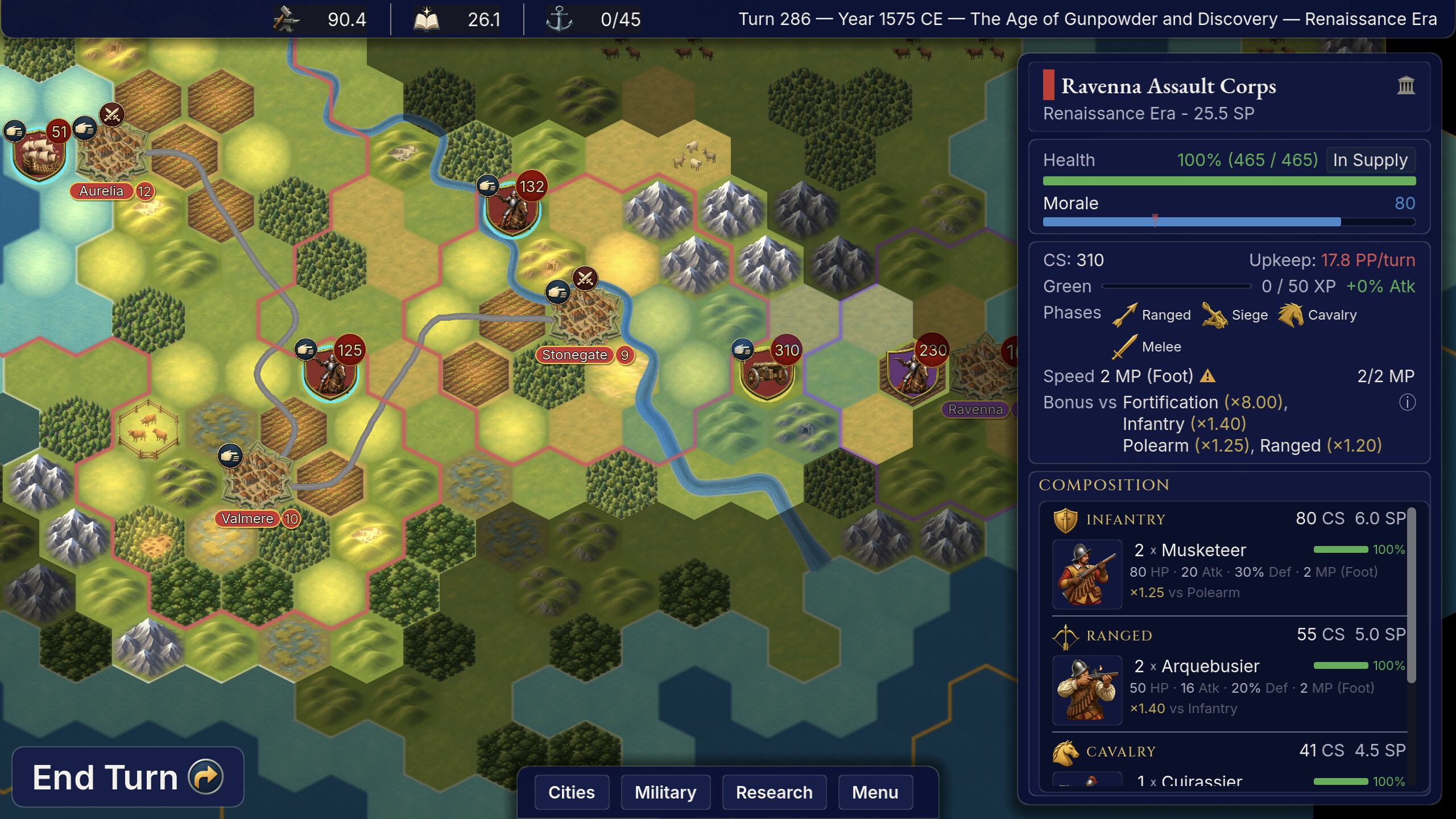
Command a civilization from antiquity to the modern era in a historical 4X focused on grand strategy over micro-management. Direct armies, research technologies, run spy networks, and shape your empire through deep, intuitive macro-mechanics.
CITIES THAT SPECIALIZE
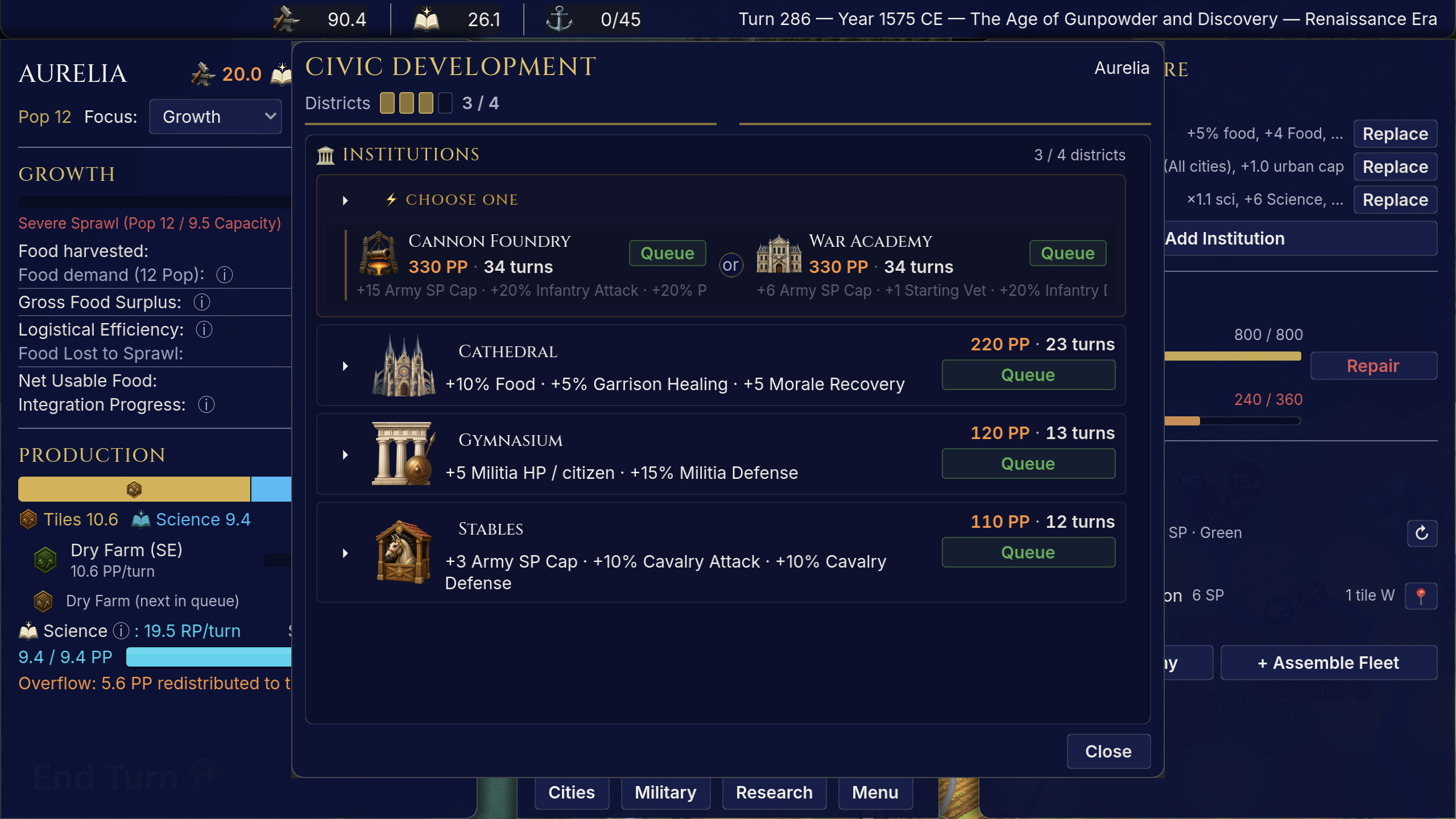
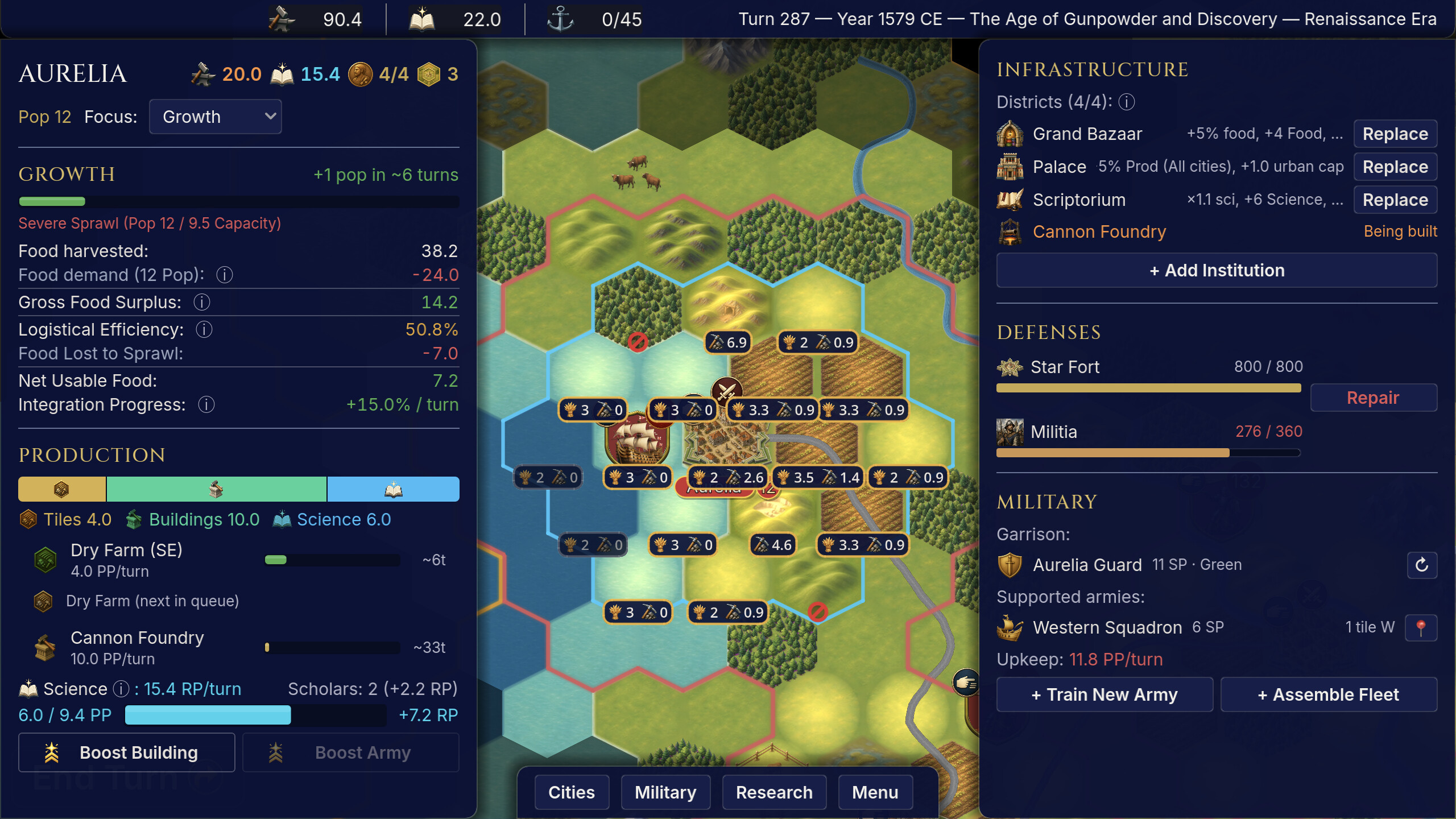
Cities are differentiated through structural infrastructure choices, not just tile output. Starting in the Classical era, several key buildings come in mutually exclusive pairs: build the Market District for trade and growth, and the Artisan Quarter — better suited to cities sitting on hills and mining terrain — is permanently locked out. By the late game, most of your cities will have settled into distinct roles and flavors based on the infrastructure choices you committed to along the way.- A single currency & Urban Capacity. No gold, no influence, no parallel economies to juggle. Production Points are the empire's entire economy — upkeep, construction, and research all draw from the same pool. However, growth is strictly bounded by Urban Capacity; a city's population will stall until you commit production to infrastructure that physically expands its urban footprint.
- Queue-driven production. Allocate Production Points to what you want built — buildings, armies, founding projects. Unspent PP converts to Research Points up to a per-city Scholarly Capacity (raised by Libraries, Universities, and similar). Beyond capacity the conversion drops off sharply, so idle production cannot be silently converted into unlimited research.
- City Focus. Each city declares its purpose. Growth and Production focuses are available from the start; Military and Science focuses unlock through later civic technologies. An automated governor handles tile-by-tile improvement decisions according to the focus, leaving the bigger picture to you.
- No settler units. There is no settler to micromanage. Mature cities project new ones through founding projects, with real constraints on distance, supply lines, and food provisioning from the parent city.
COMPOSITE ARMIES, REAL LOGISTICS
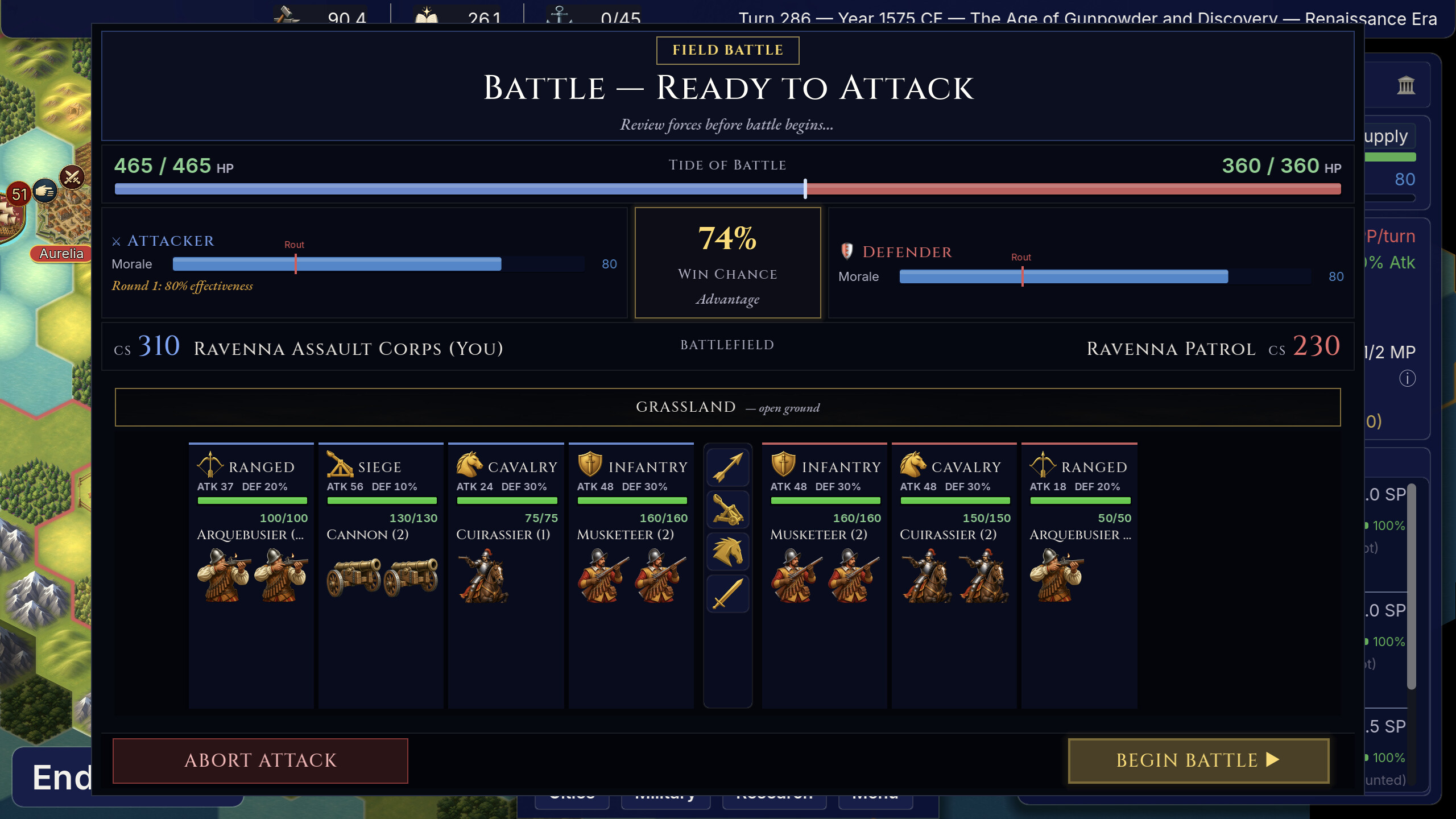
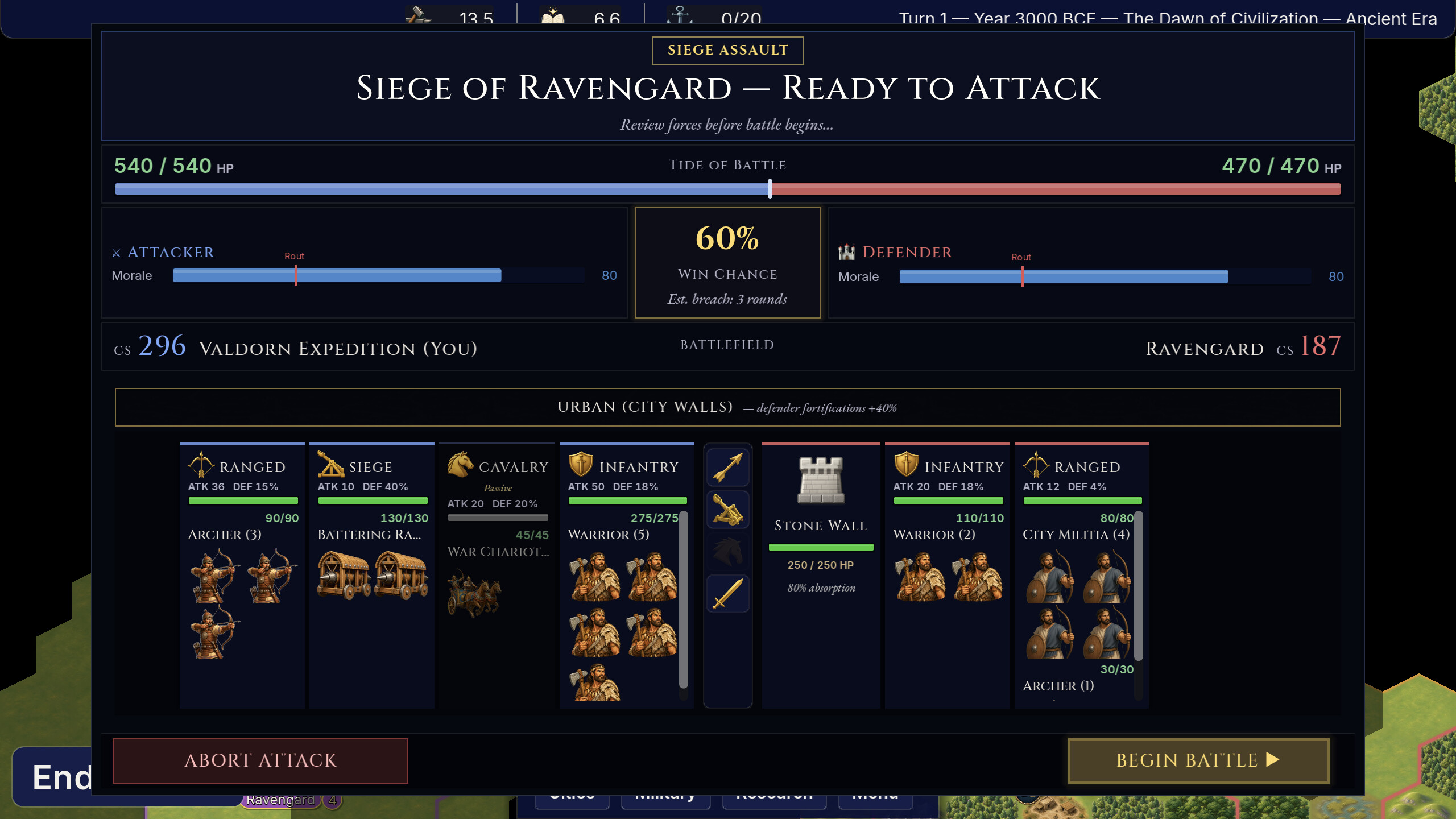
Combat is automatic and resolves over several rounds, with the option to retreat between rounds. Each round runs through structured phases — Air, Artillery, Ranged, Cavalry, Melee, Support — and your composite armies engage according to the unit classes they pool together. Type advantages, terrain modifiers, veterancy, and morale all factor into outcomes. Battles play out quickly but the results feel grounded — armies that take heavy damage break morale and rout, and sieges require actual siege weapons — you will not breach a fortified city with cavalry.The strategic layer is what gets armies into a fight:
- Supply networks with finite range, chained supply depots, and depot positions enemies can target to disrupt your campaign.
- Movement types (Foot, Mounted, Wheeled, Tracked, Motorized) that interact with terrain and roads — mountain passes matter, river crossings matter, road infrastructure matters.
- Zone of Control that turns terrain choke points into real tactical decisions without requiring you to micromanage individual units.
- Naval and air domains with embarking constrained by your port infrastructure's transport capacity, escort mechanics, coastal bombardment, and submarine stealth. Fleets patrol open water to engage hostile ships and shield vulnerable, embarked armies from interception.
- Unified urban defense — cities defend with walls, militia, and garrison together. Taking a fortified city means breaking through each layer in turn.
FIVE BRANCHES OF PROGRESS
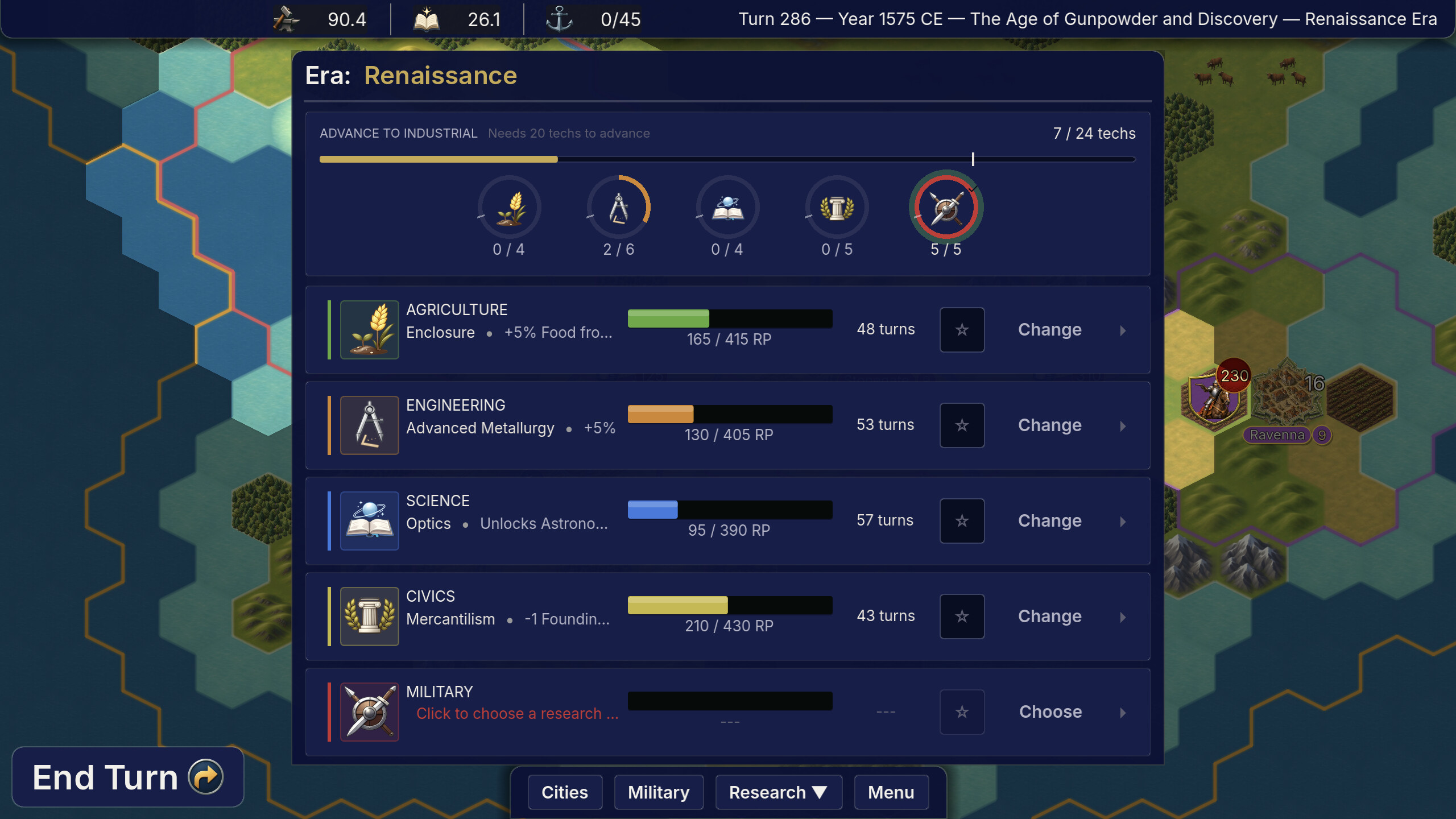
Technology is structured across five parallel categories — Agriculture, Engineering, Science, Civics, and Military — so your civilization develops as a coherent society rather than a single line on a tree.- Boost any category to accelerate research where you most need it.
- Era advancement requires meaningful breadth across all five categories. You cannot sprint through Ancient by ignoring everything but Military.
- Cross-category prerequisites create genuine strategic chains across the tree.
COVERT POWER
Beyond open warfare, you run espionage networks that gather intelligence on rivals, steal technologies, and execute sabotage. Espionage uses a deterministic friction model rather than dice rolls — the outcome of an operation is legible from its inputs, and a rival hiding a tech lead behind closed borders is a problem you can solve with patience and infiltration rather than luck.THREE PATHS TO VICTORY
The Modern Era drives the world toward a climax. As any nation closes in on a victory condition, a global Doomsday Clock appears — alerting all players to the impending threat. There are no quiet, behind-the-scenes finishes.Military Victory — Full Spectrum Dominance
Achieve a global Combat Strength (CS) of at least 1.5× the combined total of all surviving rivals to trigger a 10-turn surrender countdown. No tedious, city-by-city mop-up required. However, because CS scales dynamically with current unit HP%, a global coalition can pause or reset your countdown by damaging your forces via artillery, airstrikes, or skirmishes.
Economic Victory — Mars Colonization
Construct both a Spaceport and a Fusion Reactor to unlock the continuous Launch Mars Payload project. Every Production Point allocated across these specialized industrial hubs converts directly into tonnage toward a one-million-ton threshold. To stop you, rival nations must physically bomb your spaceports or capture your launch cities.
Science Victory — AI Singularity
Construct specialized AI Research Labs across your empire and flood them with Research Points. The Doomsday Clock displays the exact turns remaining until the Singularity completes, painting an immediate target on your top science hubs for the rest of the world.
NUCLEAR WEAPONS
The Modern Era introduces nuclear options, permanently reshaping both the map and the user. A strike scorches a seven-hex radius into a lasting wasteland. Crucially, the aggressor accumulates stacking domestic instability — protests, unrest, and lost urban capacity — while retaliatory strikes carry no such domestic penalty. Striking first cripples your own empire; striking back does not.A NOTE ON DESIGN PHILOSOPHY
Master of the Ages is built for players who value systemic depth and clear feedback. The map favors readability over visual density, and the mechanics reward long-term planning over mechanical busywork.With a unified economy driven by a single currency and an automated tile-management system, players do not need to manage individual settler movements, route spies across hexes, or handle granular micromanagement. Time spent in menus is focused entirely on making high-level, strategic decisions about the macro-development of your civilization.
Médias
Bandes-annonces et captures de la page de la boutique

Master of the Ages: Foundations of History : historique des prix et offres actuelles
Suivi des prix de Master of the Ages: Foundations of History dans les boutiques autorisées.
Avis, durée de jeu et classification de Master of the Ages: Foundations of History
Brazil le classe 10+, signalé pour Violência.
Questions fréquentes
Réponses tirées des données de ce jeu. Là où je n'ai rien, je ne dis rien.
Quelle est la classification par âge de Master of the Ages: Foundations of History ?